Individual player portraits can be useful long after photo day is finished.
When every athlete is photographed using a consistent setup, a club gains more than a collection of family photographs. It can also build a reusable library of player images for websites, social media, presentation nights, sponsor content and other club communications.
The key is consistency.
When the full roster has been photographed with similar lighting, framing and background treatment, individual images can be used together throughout the season without the club relying on mismatched phone photos or cropped team photographs.
Here are seven practical ways sports clubs can use individual player portraits.
A club website often contains team lists, player profiles or squad pages.
Individual player portraits give those pages a consistent visual structure.
Instead of using photographs taken in different locations, at different times and under different lighting conditions, the club can display players using one coordinated portrait style.
That becomes particularly valuable when an entire roster appears on the same page.
Player → portrait → team page → consistent club presentation
A coordinated portrait library can also make it easier to update team pages when a new season begins.
Clubs wanting a consistent image of every athlete can learn more about Pure Sport Images’ individual player portraits.
Clubs regularly announce teams, squads, captains and player selections.
Individual portraits give administrators a prepared image to use when those announcements are published.
Instead of searching through match-day photographs each time a player needs to be featured, the club can work from the same organised portrait library.
This can be useful for:
The benefit is not simply that a photograph exists.
The benefit is that each announcement can use an image that visually belongs to the same club and season.
Sports clubs produce a large amount of player-focused social content.
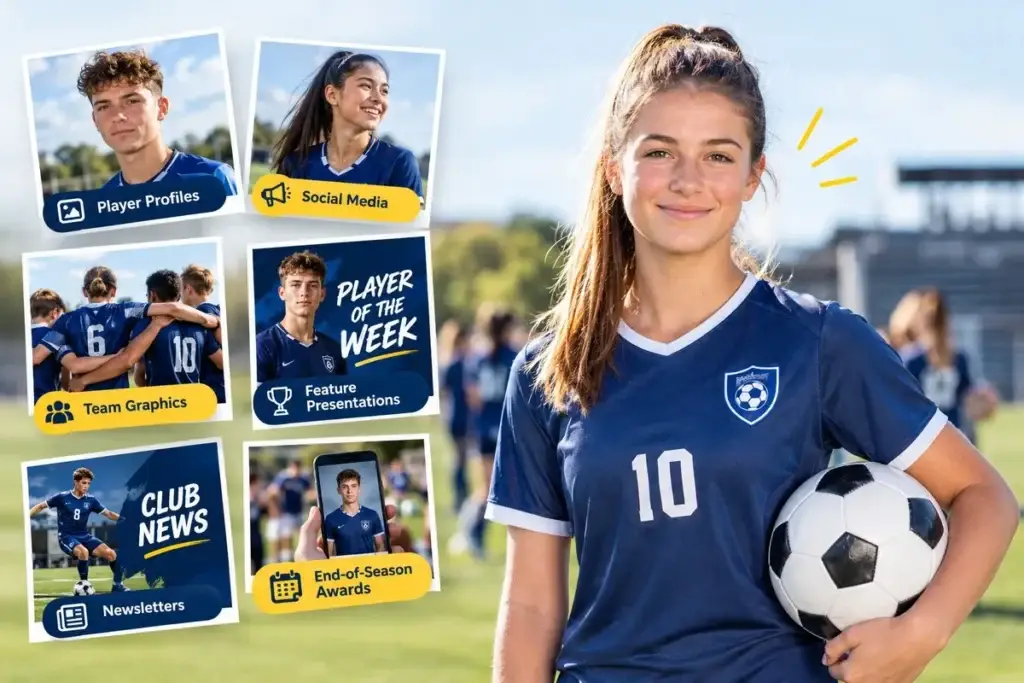
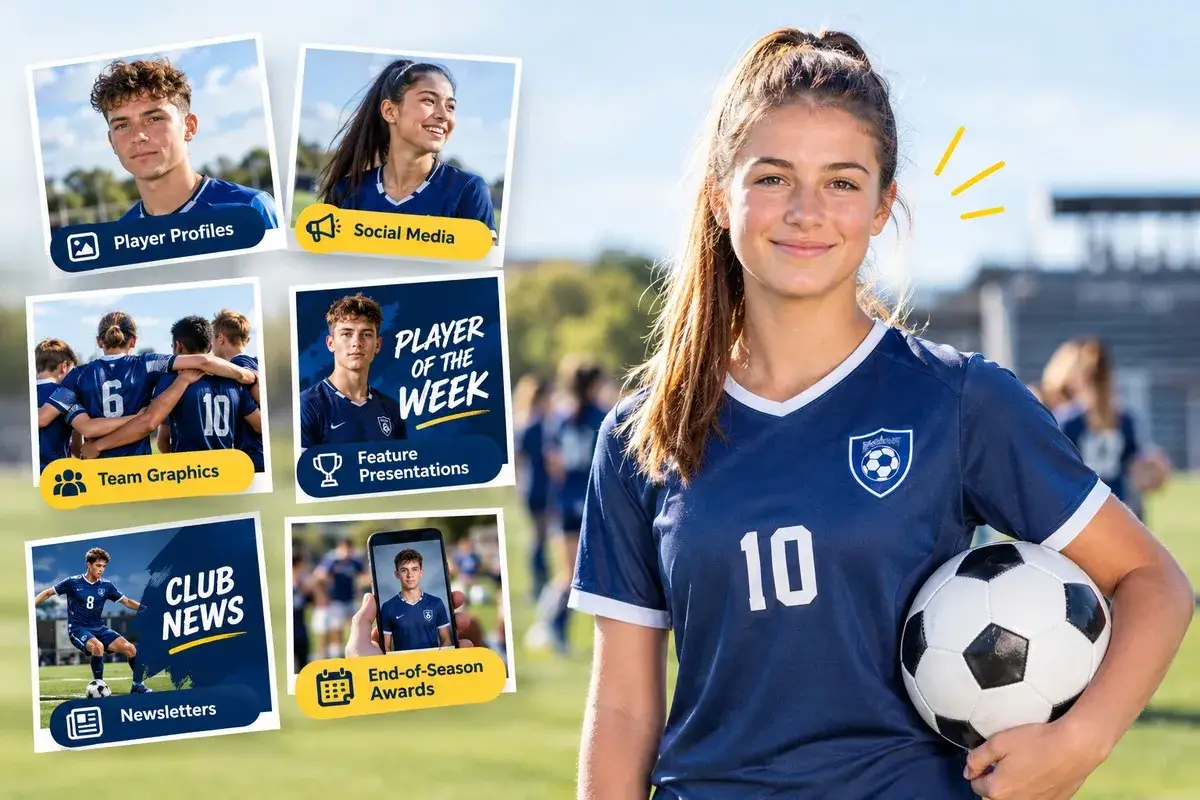
Individual player portraits can provide a consistent source image for posts throughout the year.
Examples include:
A consistent portrait also makes it easier for the club to add its own approved colours, logos or graphic elements around the player.
The photograph becomes the reusable visual asset at the centre of the post.
Imagine a club publishes five player graphics.
One player is photographed indoors against a wall.
Another is cropped from a team photograph.
Another is taken on a phone at training.
Two have professional portraits.
Even when the graphic design is consistent, the photographs make the collection feel disconnected.
Photographing the roster in one coordinated session helps solve that problem.
Player milestones are important moments for clubs. They might include:
An individual portrait gives the club a clean image to accompany the announcement.
This is particularly useful when the milestone happens months after photo day because the club does not need to arrange another portrait session or rely on whatever photograph happens to be available.
One organised photo day can therefore support content that appears throughout the season.
Player imagery can also support appropriate sponsor and partnership communications.
For example, a club may want to feature:
A consistent player portrait gives designers or club administrators a more predictable source image to work with.
Player portrait → club branding → approved sponsor content
The portrait itself does not need to contain all of the sponsor information. It provides the consistent player image that can then be incorporated into the club’s approved design.
Where a club requires more stylised photography or graphics, a dedicated media-day or player-graphics service may be more appropriate.
Presentation nights often require photographs of many players.
A club may need imagery for:
If player portraits were captured earlier in the season, the club already has a consistent image for each athlete.
This can make presentation material much easier to prepare.
Rather than searching across social feeds, match-day galleries and parents’ photographs, organisers can work from one structured player-image set.
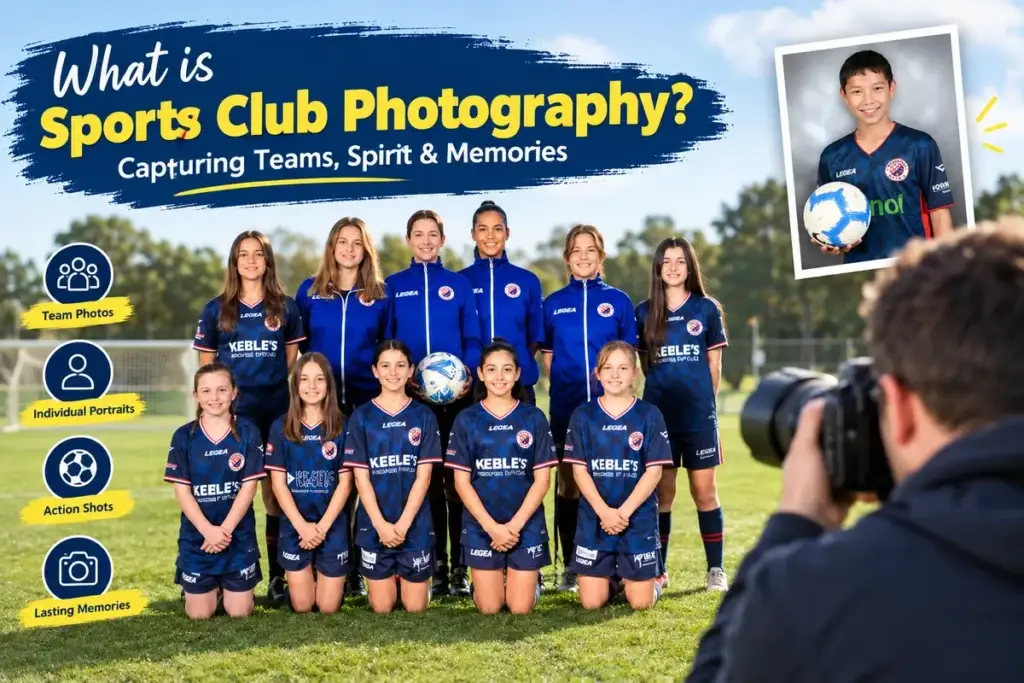
For clubs also needing a coordinated group photograph, sports team portraits can combine individual player photography with the team portrait itself.
Individual portraits can continue to be useful toward the end of the season.
Clubs may use approved images in:
The value increases when the portraits are easy to identify and organised by player and team.
A consistent library gives the club a stronger starting point whenever player-focused content needs to be created.
Photographing only a small number of players may solve one immediate content need, but it does not create a complete club resource.
A full-roster portrait session gives the club coverage across the participating players.
That means the image is already available when someone needs to be featured later in the season.
For a multi-team club, that can include several age groups or squads.
Roster → individual portraits → organised player library → season-long communication
This is one reason individual player portraits work particularly well when incorporated into an organised club photo day.
Consistency is one of the main differences between an organised portrait library and a folder of unrelated photographs.
Useful consistency can involve:
The goal is not to make every athlete look identical.
The goal is to make the images feel like they were created for the same club and the same season. This becomes especially important when several portraits are displayed together.
Team photographs and individual player portraits serve different purposes.
Most clubs do not need to choose one or the other. They can photograph both during the same organised session.
For clubs requiring the complete photography process across several teams, see Pure Sport Images’ sports team photography service.
Yes. Individual portraits can be incorporated into the same organised session as team photography.
A typical sequence may look like:
Player check-in → individual portraits → team photograph → next team
The exact workflow depends on the club, roster and photography requirements.
Combining the sessions can make it easier to photograph multiple players while they are already present in uniform and organised with their team.
It also helps the resulting individual and team images maintain a consistent visual relationship.
The photographs may ultimately support several groups.
They have access to consistent player imagery when preparing website, social or presentation content.
They can have a structured set of player images associated with their team.
Athletes receive a professional individual portrait from the club photo day.
Parents and families can access the relevant portrait products through the applicable ordering process.
They have cleaner, more consistent source photographs for approved club graphics.
One portrait session can therefore serve several purposes without requiring a new photography session for every later use.
The best time is usually when the roster, uniforms and team structure are established and the players can be organised into one planned photography session.
For many clubs, that means incorporating individual portraits into the broader team photo day.
Before the session, the club should know:
Planning those details beforehand makes the finished portrait library more useful.
Individual player portraits have much more value when the club thinks beyond a single photograph.
A consistent set can support: website profiles → team announcements → social media → milestones → sponsor content → presentation nights → season-end communications
Pure Sport Images provides individual player portraits for Melbourne sports clubs, with coordinated player photography that can be incorporated into a broader club photo day.
Individual player portraits are photographs focused on one athlete rather than the whole team. When created as part of an organised club session, the portraits can use consistent lighting, framing and background treatment across the roster.
Player portraits can be useful for appropriate club social-media content such as team announcements, milestones, player recognition and presentation material, subject to the club’s image-use requirements.
Yes. Individual portraits and team photographs can be organised within the same club photography session.
Consistency helps multiple player photographs work together across club websites, social graphics, presentation material and other communications.
No. Family photography products are one use, but clubs may also use appropriate player imagery for websites, social communication, presentations and approved promotional material.
If the goal is to create a complete roster image library, photographing every participating player produces the most useful collection.
Ready to build a consistent player portrait library for your club this season?